Art and Design
ART & DESIGN KEY STAGE 3 CURRICULUM
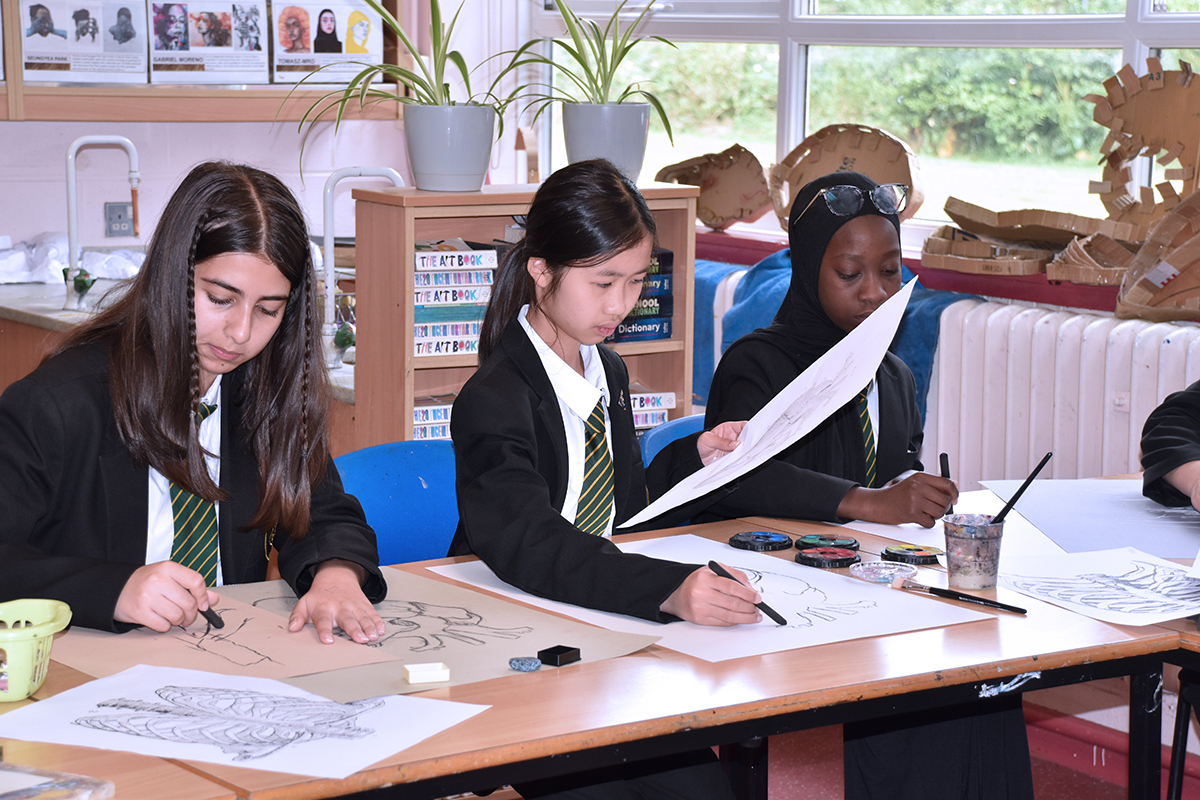
Students follow a carefully structured programme of study that develops fundamental artistic knowledge, practical skills, and understanding of the formal elements of art. The curriculum is designed to build confidence, resilience, and technical proficiency, enabling students to become independent, creative thinkers and makers who can generate, develop, and communicate their own ideas effectively.
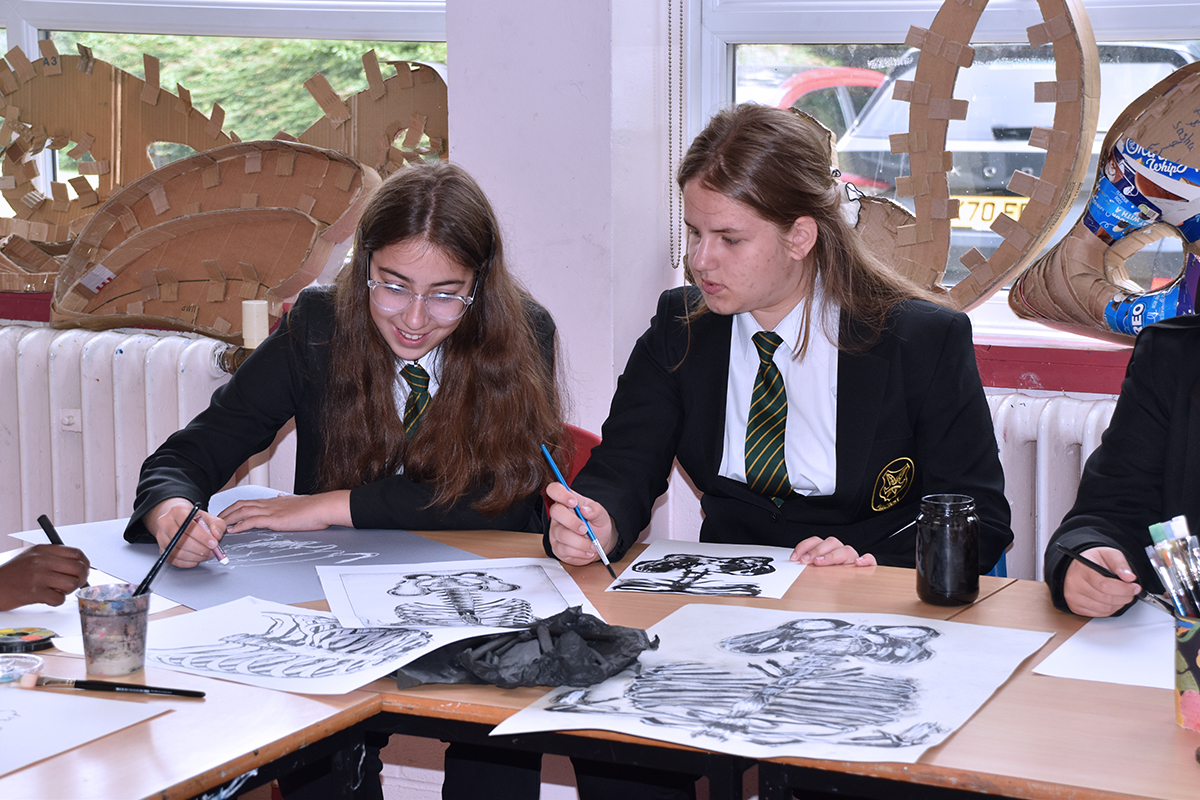
Throughout Key Stage 3, students are taught a broad range of artistic disciplines, including drawing, painting, printmaking, 3D design, ceramics, and digital media. They learn to record from first-hand observation and a variety of secondary sources, applying and refining their skills through increasingly challenging projects. As students progress, they are encouraged to experiment, take creative risks, solve visual problems, and make informed decisions about their work.
Teacher demonstrations, modelling, and exemplary materials are used to inspire, support, and inform learning. Projects are enriched through the study of artists, designers, craftspeople, and contemporary practitioners, helping students to understand how creative ideas are developed and realised in different contexts. High expectations are maintained for all outcomes, whether observational, expressive, or imaginative, and students are encouraged to take pride in their achievements. Their work is celebrated through displays across the department and wider school, fostering a culture of excellence and creativity.
Year 7 - Growing use of knowledge and skills
During Year 7, the students will be taught foundational making skills across drawing, painting and ceramics. For the first term this will look like exploring basic drawing skills and applying tonal values to develop form and texture. The students will then investigate the discipline of landscape art, inspired by both historical and contemporary practitioners. Throughout the year, the students will learn how to interrogate work through analysis and the use of the Formal Elements.
Year 8 – Creative use of knowledge and skills
Students will develop their understanding of 'drawing for purpose' through investigations into natural forms. They will use these investigations to create designs inspired by contemporary architecture and the shapes, structures and patterns found in nature. Working collaboratively in small design teams, students will develop their ideas into constructed outcomes. Throughout the year, they will continue to build confidence, skills and understanding in the use of core materials.
Year 9
At the start of the year, students further develop their confidence, control and mark-making skills through drawing. As the year progresses, they explore image manipulation through collage and stitched interventions, broadening their understanding of how different processes can be combined to create visual outcomes.
KEY STAGE 4 CURRICULUM
OCR GCSE ART: Fine Art
OPTION SUBJECT
COURSE CONTACT: MR A FEATON - HEAD OF ART, DESIGN AND TECHNOLOGY
Exam Board Website: http://ocr.org.uk/qualifications/gcse/gcse-art-and-design-j170-j176-from-2016/
Course Content
AQA Art GCSE covers practical and creative skills across multiple disciplines, assessed through a portfolio and an externally set assignment, allowing students to explore personal ideas and develop artistic techniques.
Skills and Learning Outcomes
Students are expected to:
- Develop personal ideas through research, experimentation, and reflection.
- Use a wide range of media and techniques, including traditional and digital methods.
- Analyse and respond to artists and designers, incorporating influences into their work.
- Document their creative process in sketchbooks, journals, or digital formats, showing development, refinement, and annotation.
- Demonstrate critical thinking and problem-solving in visual communication and design.
Assessment Details
The AQA Art GCSE is divided into two main components:
Portfolio (Coursework), 60% of GCSE: Students create a body of work over the course of study, including a sustained project and additional pieces that demonstrate skills across different areas. This portfolio shows the journey from initial research and experimentation to final outcomes. This may include practical work created using drawing, painting, sculpture, photography, textiles, or digital media.
Externally Set Assignment (ESA), 40% of GCSE: Students respond to a starting point provided by AQA. After a preparation period, they complete 10 hours of supervised work to realise their ideas. This component tests the ability to integrate knowledge, skills, and understanding developed during the course.
Assessment Objectives
All work is assessed against four objectives:
AO1: Develop ideas through investigations, demonstrating understanding of sources.
AO2: Refine ideas through experimenting with media, materials, techniques, and processes.
AO3: Record ideas, observations, and insights relevant to intentions.
AO4: Present a personal and meaningful response that realises intentions.
Key Points for Success
- Work consistently throughout the course rather than leaving projects until the last minute.
- Document all stages of work, including experiments and unsuccessful attempts.
- Respond to feedback and refine ideas.
- Experiment boldly with materials and techniques to demonstrate creativity and skill.
KEY STAGE 4 CURRICULUM
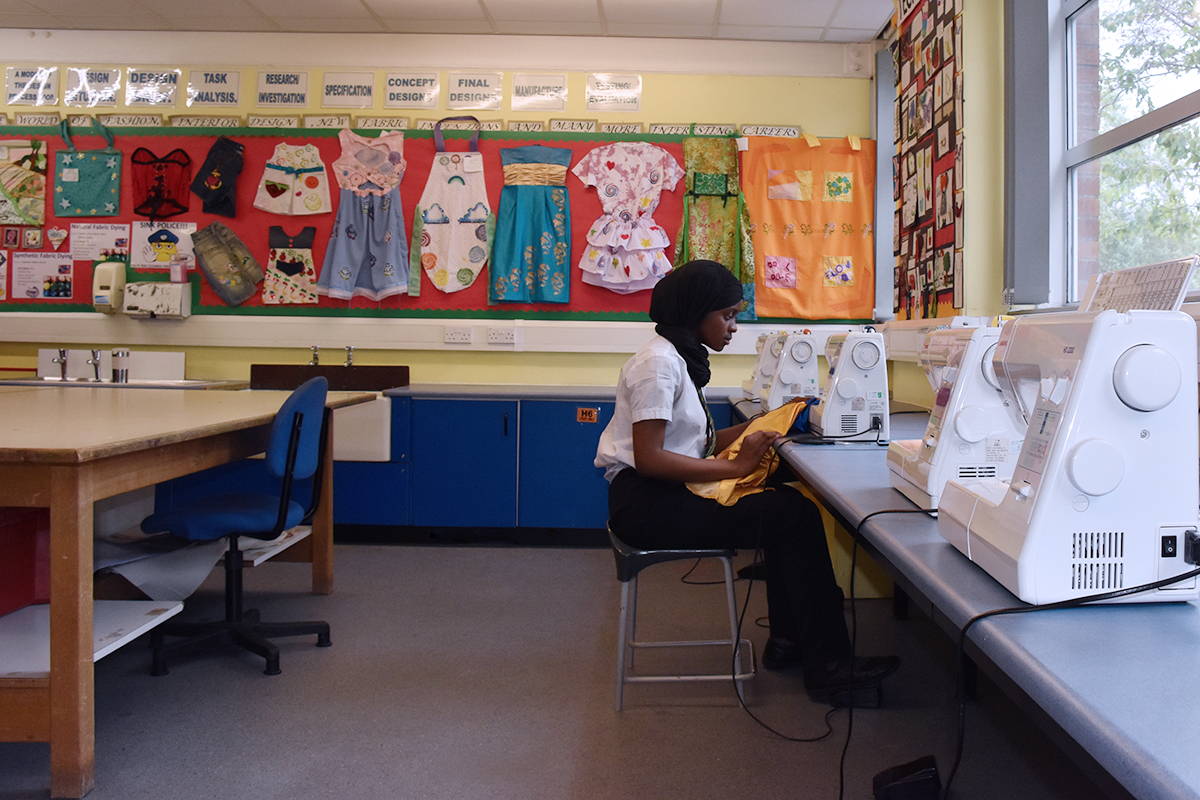
OCR GCSE ART: Textile Design
OPTION SUBJECT
COURSE CONTACT: MR A FEATON - HEAD OF ART, DESIGN AND TECHNOLOGY
Exam Board Website: http://ocr.org.uk/qualifications/gcse/gcse-art-and-design-j170-j176-from-2016/
Course Content
AQA Textile Design GCSE covers practical and creative skills across multiple disciplines, assessed through a portfolio and an externally set assignment, allowing students to explore personal ideas and develop artistic techniques.
Skills and Learning Outcomes
Students are expected to:
- Develop personal ideas through research, experimentation, and reflection.
- Use a wide range of media and techniques, including traditional and digital methods.
- Analyse and respond to artists and designers, incorporating influences into their work.
- Document their creative process in sketchbooks, journals, or digital formats, showing development, refinement, and annotation.
- Demonstrate critical thinking and problem-solving in visual communication and design.
Assessment Details
The AQA Art GCSE is divided into two main components:
Portfolio (Coursework), 60% of GCSE: Students create a body of work over the course of study, including a sustained project and additional pieces that demonstrate skills across different areas. This portfolio shows the journey from initial research and experimentation to final outcomes.
Externally Set Assignment (ESA), 40% of GCSE: Students respond to a starting point provided by AQA. After a preparation period, they complete 10 hours of supervised work to realise their ideas. This component tests the ability to integrate knowledge, skills, and understanding developed during the course.
Assessment Objectives
All work is assessed against four objectives:
AO1: Develop ideas through investigations, demonstrating understanding of sources.
AO2: Refine ideas through experimenting with media, materials, techniques, and processes.
AO3: Record ideas, observations, and insights relevant to intentions.
AO4: Present a personal and meaningful response that realises intentions.
Key Points for Success
- Work consistently throughout the course rather than leaving projects until the last minute.
- Document all stages of work, including experiments and unsuccessful attempts.
- Respond to feedback and refine ideas.
- Experiment boldly with materials and techniques to demonstrate creativity and skill.
Why Study this Course?
Students should consider Art and Design if they are considering any career in the creative industry. These include, but are not limited to illustration, graphic design, theatre design, film production, architecture, magazine publishing, book publishing, journalism, product design, animation, interior design and fine art.
Art is also a course that encourages students to think in different ways – often making them more able to deal with different situations in a more creative way and is, therefore a highly suitable course for most career paths.
Art and Design Reading List
Art/Design Technology Careers in the Curriculum Priorities
Careers intent statement: Art, Design & Technology.
The Art DT department is committed to ensuring students study a wide and varied curriculum delivered by subject specialists. Pupils can access relevant career focused information and develop skills which will give the opportunity to explore future career development.
- Careers links identified in lessons will help to make informed choices regarding future career pathways across all areas of Art and Design Technology. This will support and enhance the development of both transferable and employability skills gained throughout KS3 to be effectively utilised within KS4 and beyond.
- To develop departmental visual resources covering the wide variety of career opportunities for pupils to consider moving forward.
- Across the department there are many key elements to focus on, including problem solving, creativity, practical activity, analysis and evaluation. These will help pupils to gain experience and encourage them with the confidence to use their skills and knowledge for the world outside the classroom, better preparing them for their potential chosen career path.
- Pupils are encouraged to believe in their own abilities and be ambitious and confident enough to be creative, innovative and inspirational to themselves and their peers.
The impact of careers in curriculum intent will be measured by student voice and evaluation exercises